

The Odyssey Movie
Fact and Fiction
4 Sept 2026
Christopher Nolan’s blockbuster has been a massive financial and critical success. I thought it was fun. It’s not perfect, of course, not least because if you don’t already know the story, it was a little confusing to follow. However, I think it’s unfair to complain about it being inaccurate. The story is a work of fiction and claims that lurking behind the original poem is some sort of historical event doesn’t seem to me very helpful.
The Historical Background
Over the years there have been numerous books and documentaries centred around The World of Odysseus, tracing his travels across the Mediterranean and using the archaeological evidence of the Mycenaean Period to give such accounts an aura of authenticity, but there is so much speculation and guesswork involved that it is ultimately a rather pointless exercise.
Fortunately Nolan generally lets the story tell itself without too much rationalising of events. But even he falls into the trap of suggesting that the underlying motive for the siege of Troy was the strategic trading position of the city on the coast of Turkey, despite the fact that there is no evidence that the Greeks thought in such economic terms, even in much later times. If you want a simple explanation for attacking Troy, in which Helen becomes just an excuse, plunder is far the most likely answer.
And why not? Plundering enemy cities and killing or enslaving their populations, was undoubtedly a part of Greek culture, however repellant it may be to us. Odysseus does his share of plundering shortly after setting off from Troy on his way home. In Book 9 of The Odyssey he recounts:
The wind behind me brought me from Ilium to Ismarus, the town of the Cicones. I sacked the town and I killed the men. As for the women and all the chattels that we took, we divided them amongst us, so that none of my men, if I could help it, should depart without his fair share.’
Odyssey Book IX 39-42 (translated by Walter Shewring OUP)
The moral dimension?
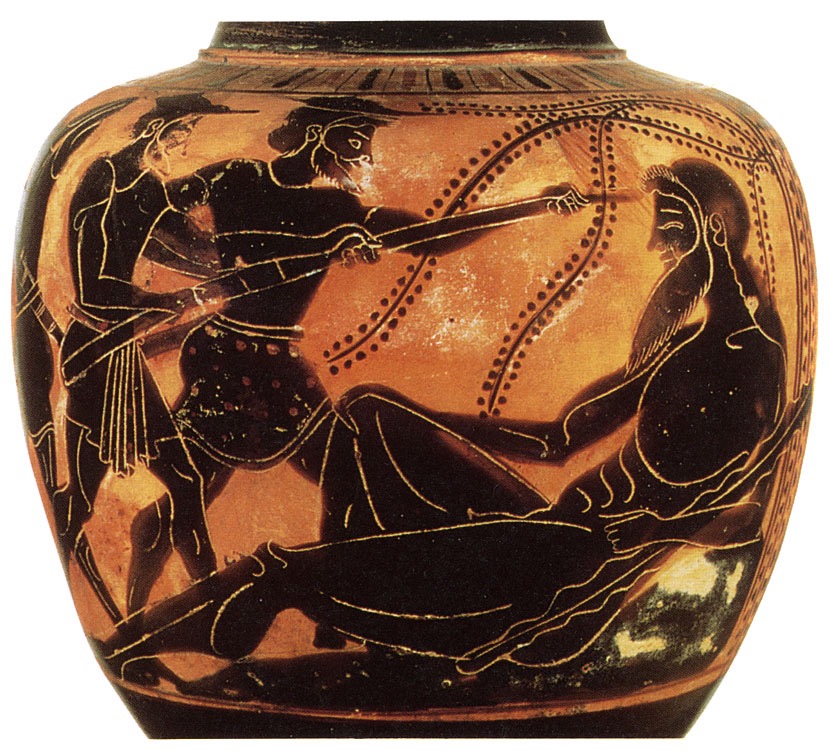
So it is somewhat ironic that Nolan’s biggest change to the original story is to make Odysseus regret the killing and destruction of Troy. In his version, our hero is eventually plagued with guilt and at the very end of the film embarks on a quest to appease the gods for the destruction he has caused through his creation of the wooden horse. Of course, there is nothing wrong in giving the film a 21st Century moral twist. It turns Odysseus into the sort of tormented hero very much in the modern mould, but in Homer’s original tale his motivation is much more straightforward. He needs to appease Poseidon for blinding the Cyclops, his son, and boasting about it. He is told by Teiresias in the Underworld to travel inland with an oar until he comes to a people who are so far from the sea that they think the oar is a winnowing fan (used to separate grain from husks). Then he must plant it in the soil and offer a sacrifice to the god.
This is not a question of morality. There is no suggestion that Odysseus was wrong to blind Polyphemus in order to save himself and his men and Odysseus certainly shows no guilt. In fact he never shows guilt about anything, only occasionally regret at a misjudgement. All the same he has offended an important god and you can’t get away with that.
The Homeric Code
The Odyssey may have no factual basis but it does have a coherent ethical framework (that presumably evolved during the period of its conception), and this is why the story works and is not just a series of loosely connected episodes. In the world of Odysseus, there is an over-riding obligation to honour and fear the gods and this has ethical implications. The most important of these is to respect the conventions of hospitality. It is a requirement, sanctioned by Zeus, to host strangers, giving them food and allowing them shelter. However, there is also an obligation for strangers not to abuse that hospitality.
It is often argued that the Odyssey as a whole is an exploration of these obligations. While it is doubtful that whoever put the story together was thinking in these terms, it is certainly true that the story revolves around the various ways in which hosts and guests behave towards each other. Here are a few of the most prominent examples. The monstrous beings, the Laestrygonians and Cyclopes, ignore the laws of hospitality altogether and eat Odysseus’ men. The demi-gods, Circe and Calypso subvert the laws of hospitality by keeping Odysseus under their spell far too long, while the suitors make a mockery of the conventions by refusing to leave Penelope and consuming the wealth of Odysseus’ house. Their punishment is just on every level.
However, it is not quite as simple as that. The Phaeacians (in an episode entirely missed out in the film) treat Odysseus with respect and make sure he reaches home safely. So you might think they would be rewarded by the gods for their generosity, but in fact Poseidon is angry with them for helping Odysseus and punishes them.
Which brings us back to the obligation that over-rides everything else, the need to honour and respect the gods and the danger, even inadvertently, of offending one of them.
The Lessons of the Odyssey for Classical Greeks
These aspects of Greek culture did not disappear in Classical times, and in my books I have tried to reflect them. Lykos, even though he is only twelve years old, is acutely aware of his duty to the gods, especially thanking them when he has had some success. And when he stumbles on a farm near Argos in his wanderings, the family feels obliged to give him hospitality even though they are uncertain of his status. Before he leaves, Lykos in his awkward way, tries to mimic the conventions of guest-friendship by exchanging gifts.
I put this episode into the story because I believe there was a strong continuity between the mythical past and historical present for the Greeks of the Classical period. It is not easy to know how far ordinary Greeks viewed The Odyssey as fact or fable but it was an epic tale that they all shared and all understood. It was embedded into their culture. The world of Odysseus might be a fiction but it was real to the Greeks and part of their identity.